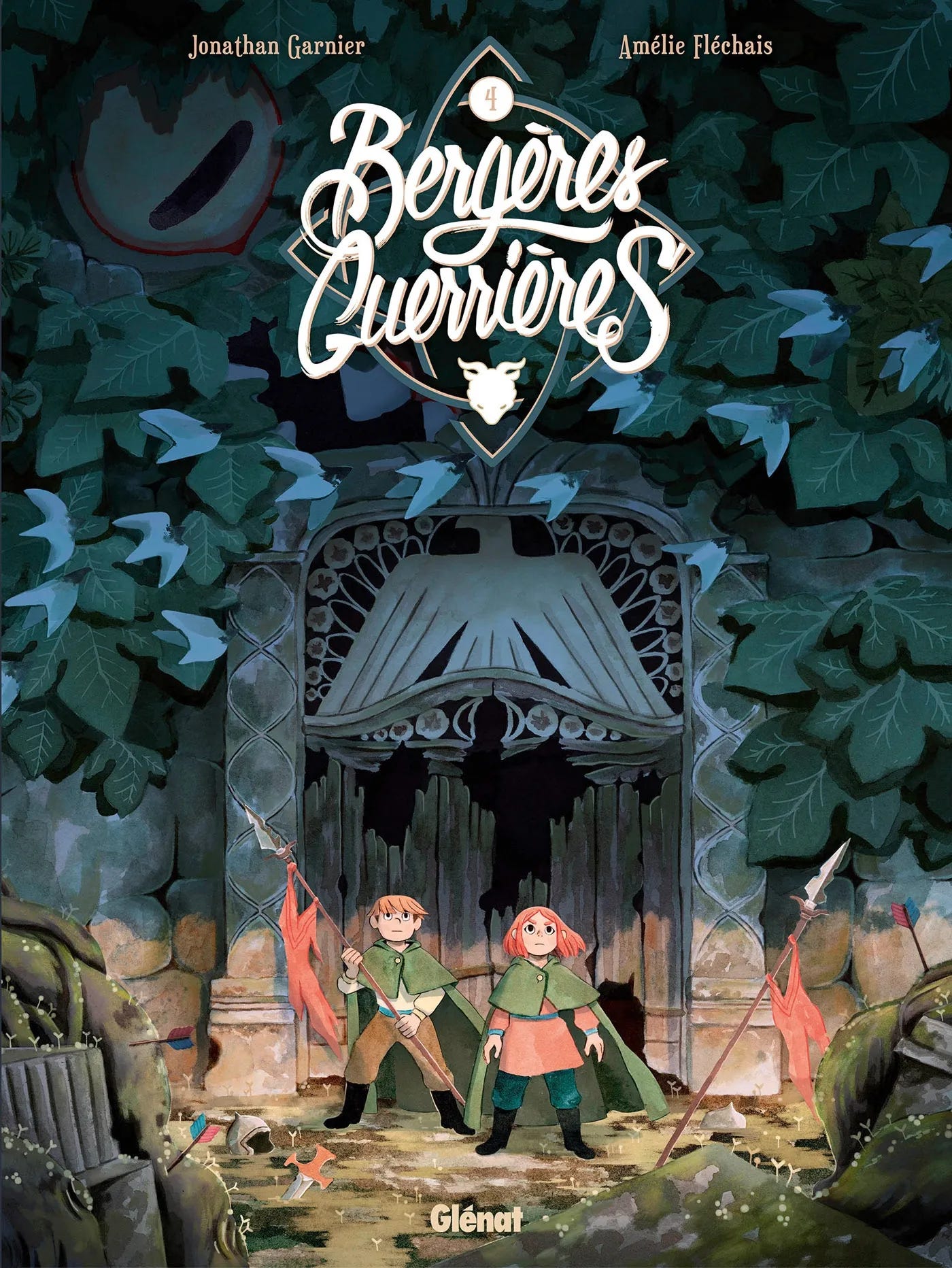
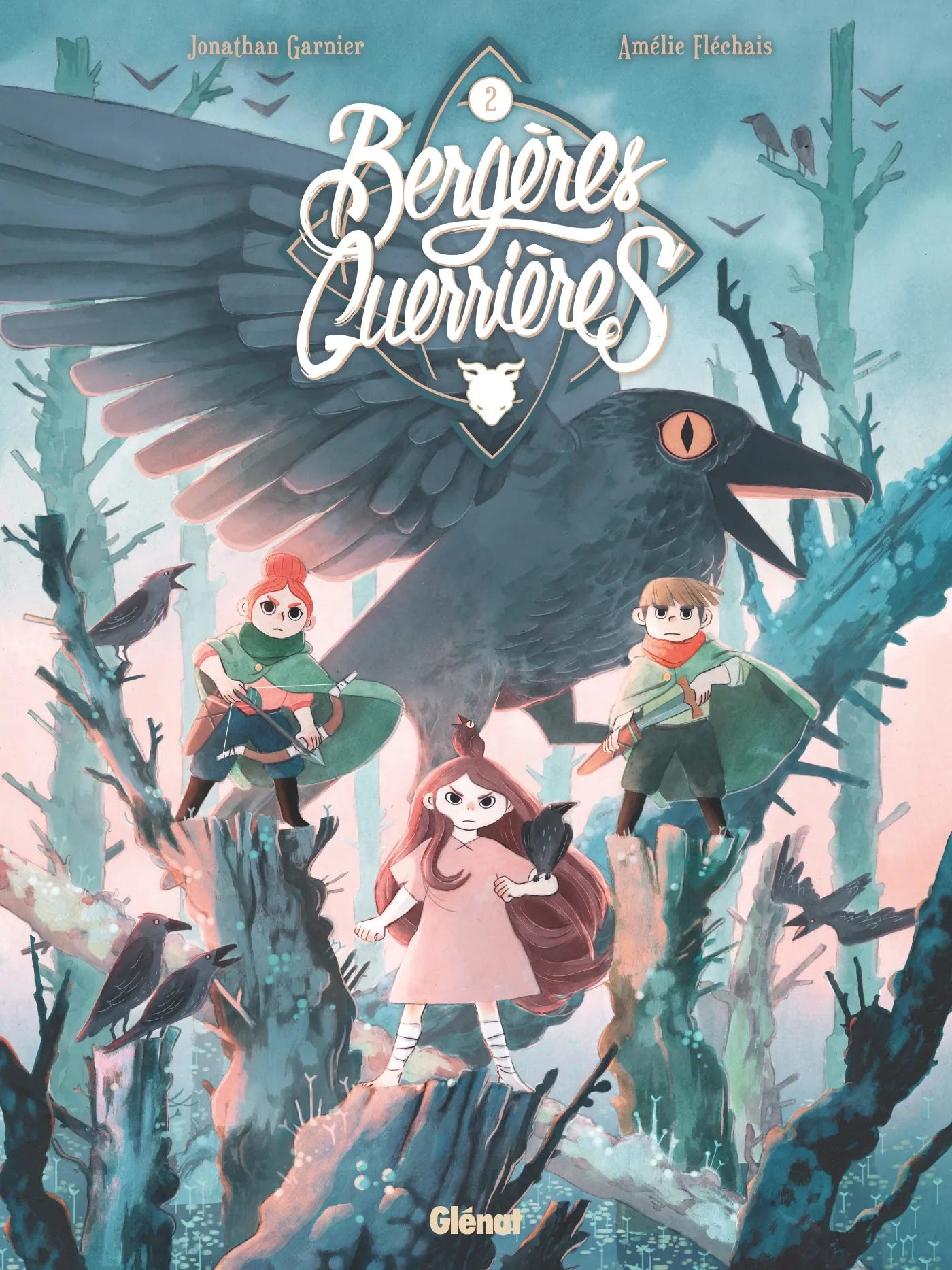
As you may know, the Shepherdess Warriors - Epilogue art print is currently available on LiberDistri! As part of this limited sale (February 13-16, 2026), we present an interview with artist Amélie Fléchais, illustrator of the comic book series Shepherdess Warriors (written by Jonathan Garnier). This interview was conducted by our partner Thomas Olivri from Geek-Art.
If you enjoy Amélie Fléchais' art, if you are a fan of Shepherdess Warriors, if you like illustrations full of tenderness, if this interview makes you want to purchase the print, then hurry, because the sale ends tonight at 6 p.m. ... This is your last chance! ⏳
For your information, the prints will be numbered according to sales, signed by Amélie Fléchais, and come with a certificate of authenticity. They will be in a large format (61 x 91 cm), perfect for showcasing the splendid illustration that the artist has drawn for us. ✨
Now, we will leave you with the interview, so sit back, relax, and grab a cup of coffee! Enjoy! ☕
"Shepherdess Warriors - Epilogue" - Art by Amélie Fléchais - Geek-Art - Caurette - Glénat
Interview conducted by Geek-Art
First of all, could you briefly introduce yourself to our readers? Where do you come from, where do you work… and how did you get into illustration?
I was born in Le Mans, France, but I spent part of my childhood and teenage years in Africa, in Côte d’Ivoire and Gabon, which somewhat influenced my graphic style and, in particular, gave me a passion for patterns.
I was fortunate to grow up in a family that loved books very much. My mother was a schoolteacher, so I had access to many illustrated books from an early age, and my father was passionate about comics, which meant I had a library full of classics within easy reach. That is probably what made me want, as I grew up, to start drawing and telling stories of my own.
Amélie Fléchais / Jonathan Garnier / Glénat
As a teenager, I hesitated between fashion design, illustration, and animation. Eventually, I realized that what I truly wanted was to tell stories. I first enrolled in a comic art program at the Beaux-Arts in Angoulême, which didn’t fully convince me, and then shifted toward animation studies at ESAAT in Roubaix, where I graduated.
I loved animated filmmaking, but it’s a medium that requires an enormous amount of work for even a single minute of film. I felt somewhat frustrated by not being able to tell my stories as quickly as I wanted. So alongside my studies, I continued creating comics as a self-taught artist and published them on a blog. Those comics were noticed by a publisher (Jonathan Garnier), who contacted me while I was still studying. Once I had my animation degree, I ultimately began working in comics, while also taking on freelance projects in animated film.
Art by Amélie Fléchais
How would you describe your visual universe? How did you manage to “find” it, and when did you realize, “That’s it — this is what I want to do for the rest of my life”?
It’s a bit complicated to describe one’s own visual universe, but I suppose it could be described as “retro/folk.” It has developed over time, shaped by my experiences, the countries I’ve had the chance to visit, and my readings. Some illustrators have had a major influence on my work, such as Tove Jansson, Jiří Trnka, Alice and Martin Provensen, and of course Hayao Miyazaki. I really appreciate the duality in their work, which blends a dreamlike, “childlike” world with stories that can sometimes be dark and explore more mature themes. I wanted to bring that same duality into my own work. I’m not sure yet whether I want to do this for the rest of my life, but as long as I’m enjoying myself and feel the desire to create worlds and tell stories, I’ll keep going for as long as I can.
Art by Amélie Fléchais
Under what circumstances did you come up with the idea for the Shepherdess Warriors, which you illustrate with Jonathan Garnier as writer?
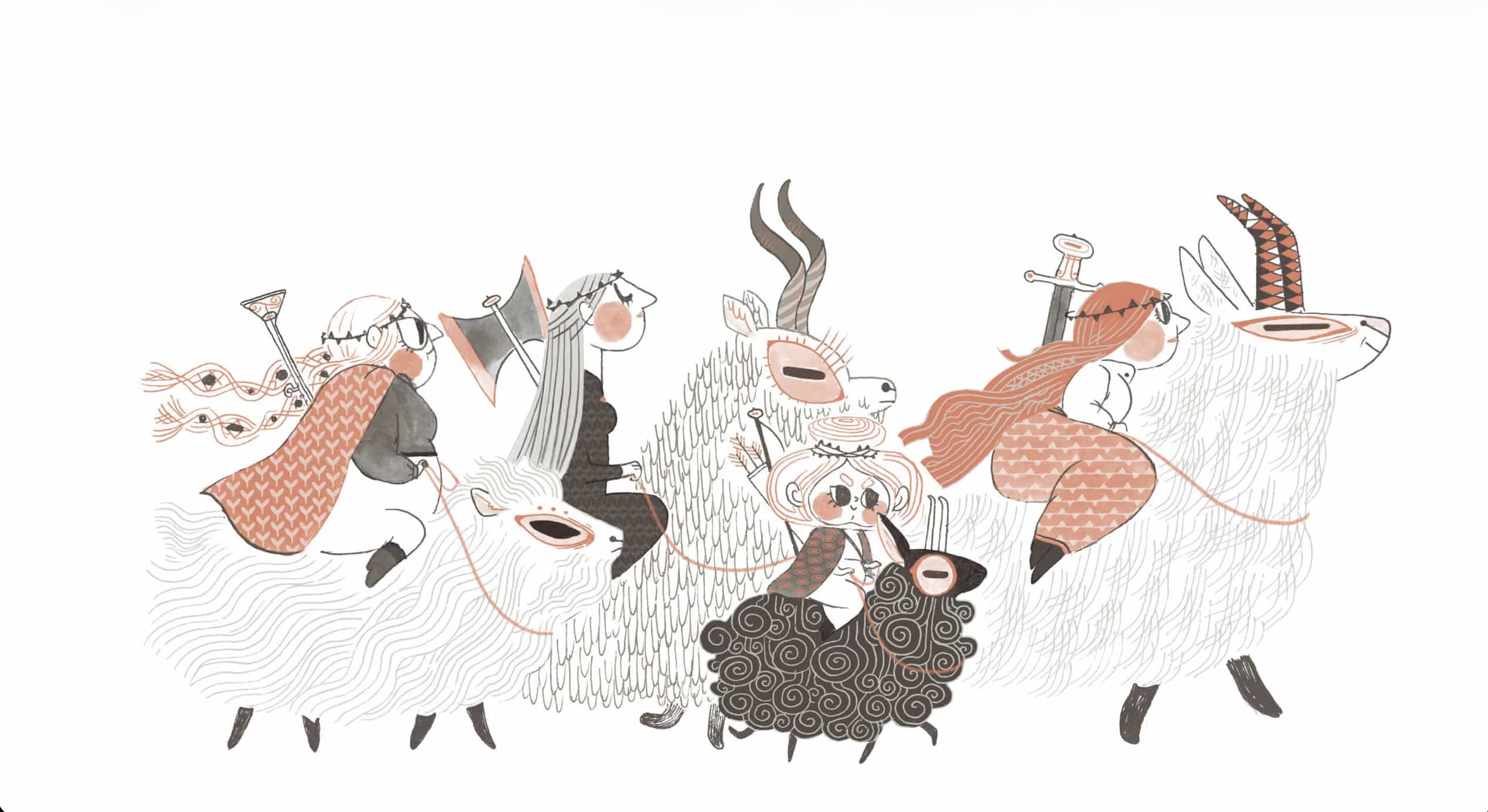
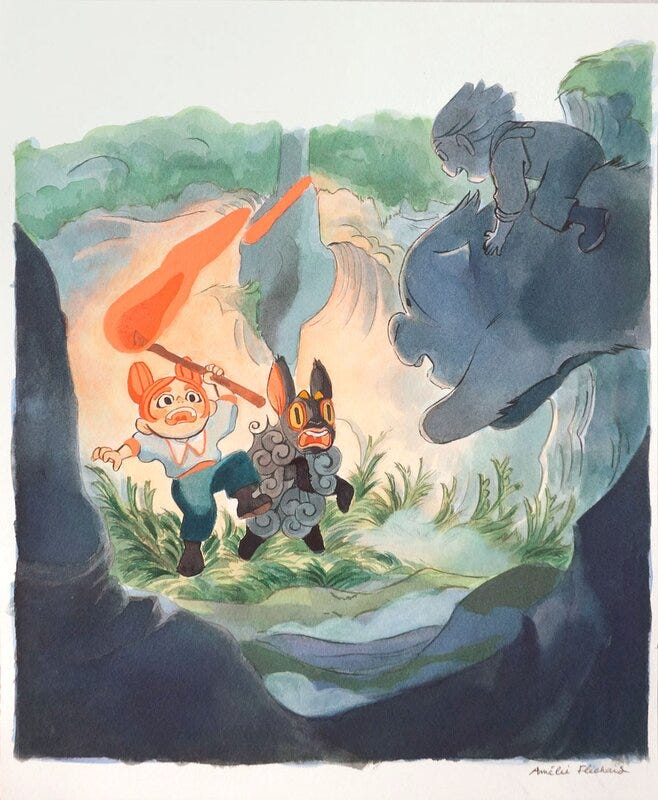
The project was born somewhat by chance. In 2013, I was contacted by illustrator Faustine Tarmasz to take part in a collective book project titled Cavalry. As the title suggests, the concept was to depict riders in two illustrations. But at the time I wasn’t very good at drawing horses, and I also have to admit that drawing armored knights didn’t inspire me very much. So I drew a kind of Amazons riding goats and named them the “Shepherdess Warriors.” In these illustrations there were four characters who seemed related: a child, two adult women, and a grandmother, who later became Molly, her mother, her aunt, and her grandmother.
Art by Amélie Fléchais
When Jonathan saw these drawings, he was immediately inspired by these warrior women, who offered strong potential for an adventure in which family relationships would play a central role. We began imagining a story around them and asked ourselves a question: why have these women taken up arms and why are they riding goats?
This connected with a theme he wanted to explore in a script: war from the perspective of those who stay behind — women, children, and the elderly who must continue living without their fathers, husbands, and brothers, mobilized to fight far from home. That became the central theme of our story.
Art by Amélie Fléchais
What advice would you give to young people who want to become illustrators?
To be as curious as possible about everything around them and to take an interest in all forms of art. It’s important to constantly question yourself and to keep pushing your work to evolve. And, of course, to persevere, because the current climate isn’t the most favorable for starting out in this profession.
Art by Amélie Fléchais
What is your vision of the profession and its challenges?
It’s a wonderful profession that, unfortunately, is still not fully recognized as a “real” job. There have been small steps forward, but there is still a lack of genuine recognition for our status and our skills — and that’s unlikely to change anytime soon, especially with the rise of AI generating illustrations in just a few seconds. It creates the impression that making art is easy, when in reality these generated images are the result of massive appropriation. We can only hope that new laws will come into effect in the coming years to better protect artists.
Art by Amélie Fléchais
What is your favorite piece in your portfolio, and why?
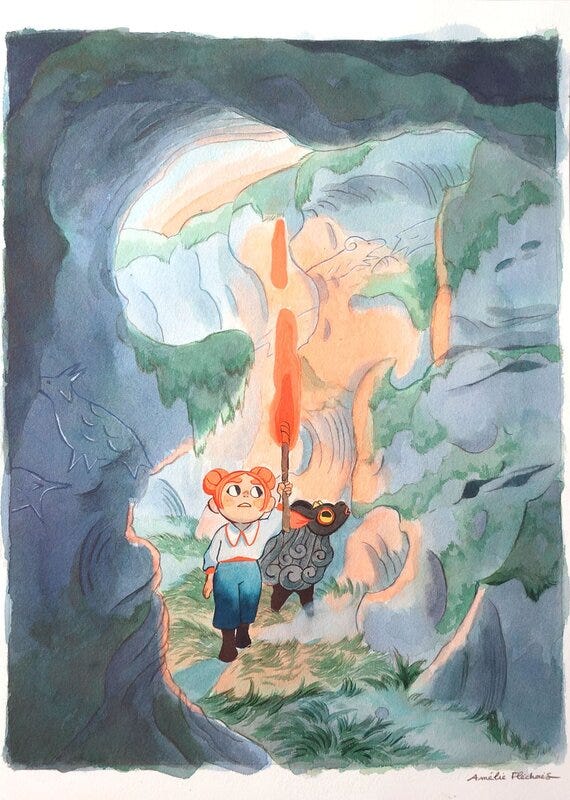
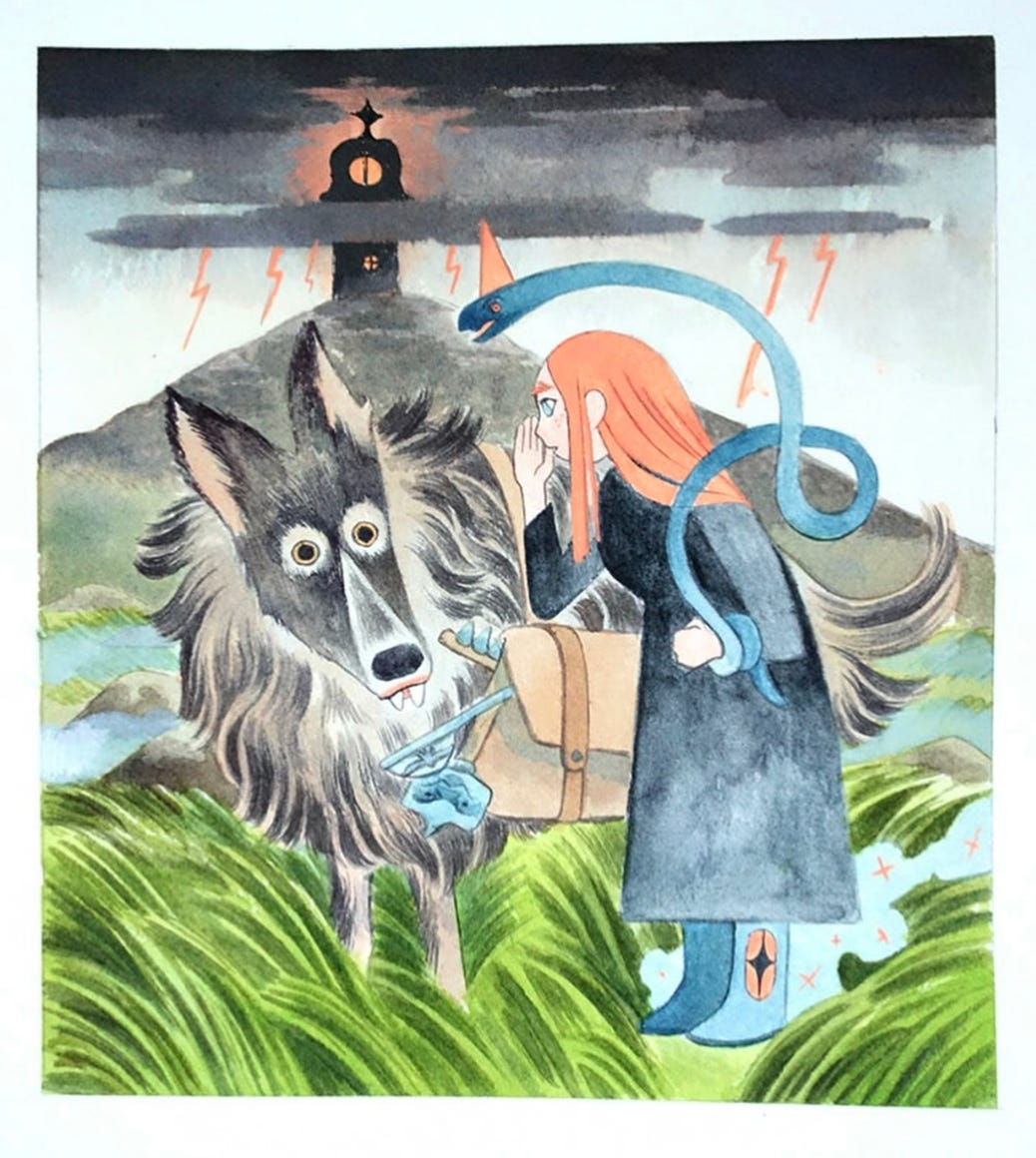
It changes regularly, but at the moment it’s one of my latest illustrations, “3-BOOTS.” I love it because it feels like a scene taken from a larger story, and every time I look at it, I imagine a different narrative unfolding. I would really love to bring those characters to life in a story one day.
Art by Amélie Fléchais
Finally, a quick question about the print: how did you approach it technically? Why this particular visual — can you tell us a bit more?
I created this visual with the intention of offering an iconic image that captures the spirit of the series.
I wanted to stage a kind of luminous epilogue that reconnects with the atmosphere of the beginning of the adventure, while contrasting with the melancholy tone of the ending. We see our three heroes, slightly older, back home, and seemingly ready to set off on a new journey.
It was actually an image we hesitated to include at the end of the final volume, because it may have wrapped up the themes a little too gently. I’m therefore happy to be able to share it with readers a few years later through this illustration.
I used my usual working method, the same one I rely on for creating covers. I start by painting the setting and characters in watercolor on paper, in order to preserve textures and happy accidents, and to avoid the overly “smooth” feel of fully digital work. Then I refine the drawing in Photoshop, adding shadows, highlights, and details.
Art by Amélie Fléchais
➡️ If you would like to discover other artists and read more interviews like this, you can subscribe to the Geek-Art newsletter by clicking here!